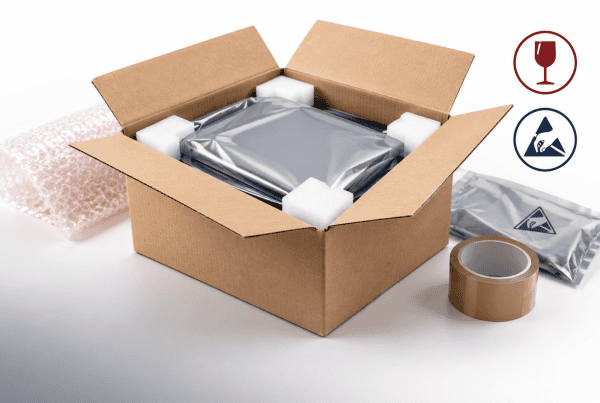
A box that is only a few inches too large can increase shipping costs, require extra cushioning, and let the product move in transit. A box that is too small can place pressure on the contents, weaken the seams, or leave no room for protective material.
This guide explains common box sizes, how shipping box dimensions are written, and how to choose a carton based on the packed product rather than guesswork. It is designed for eCommerce sellers, warehouses, offices, manufacturers, movers, and anyone comparing cardboard box sizes for regular shipments.
Key takeaways
- Box dimensions are normally written as length × width × height.
- Published carton measurements usually describe the usable inside dimensions.
- There is no single universal list of standard box sizes for every supplier or carrier.
- Measure the fully packed product, including padding, inserts, bags, and dividers.
- Use the smallest box that provides enough cushioning and closing clearance.
- Compare actual weight with dimensional weight before approving a shipping carton.
- Test box strength as well as size, especially for heavy, fragile, or stacked shipments.
Common box sizes chart
The table below covers widely used rectangular and cube-style cartons. Treat it as a practical box sizing guide rather than a universal manufacturing standard. Exact dimensions, board strength, and availability vary by supplier.

| Common box size | Approximate volume | Typical uses | Important sizing note |
| 6 × 6 × 4 in. | 144 cu. in. | Small parts, hardware, cosmetics, samples | Limited room for cushioning around fragile items |
| 8 × 6 × 4 in. | 192 cu. in. | Accessories, candles, small electronics | Useful for compact products with a low profile |
| 8 × 8 × 8 in. | 512 cu. in. | Mugs, jars, small grouped products | A versatile cube for single-item shipments |
| 10 × 8 × 6 in. | 480 cu. in. | Books, boxed food, beauty products | Works well for many small eCommerce orders |
| 10 × 10 × 10 in. | 1,000 cu. in. | Product bundles, kitchenware, supplies | Cube shape can simplify packing and stacking |
| 12 × 9 × 6 in. | 648 cu. in. | Apparel, documents, subscription products | Low height reduces empty space for flatter goods |
| 12 × 10 × 8 in. | 960 cu. in. | Shoes, small appliances, retail orders | Common general-purpose shipping format |
| 12 × 12 × 12 in. | 1,728 cu. in. | Home goods, grouped products, small equipment | One cubic foot before allowing for wall thickness |
| 14 × 10 × 6 in. | 840 cu. in. | Folded clothing, books, elongated products | Better than a cube when the item is long and shallow |
| 14 × 12 × 10 in. | 1,680 cu. in. | Medium product bundles, office supplies | Allows moderate cushioning on multiple sides |
| 16 × 12 × 8 in. | 1,536 cu. in. | Apparel orders, electronics, household goods | A useful medium rectangular carton |
| 16 × 16 × 16 in. | 4,096 cu. in. | Linens, larger household goods, bulk products | Can become costly when filled with lightweight goods |
| 18 × 18 × 16 in. | 5,184 cu. in. | Kitchenware, toys, grouped inventory | Check dimensional weight before regular use |
| 18 × 18 × 18 in. | 5,832 cu. in. | Moving, storage, bulky retail products | Avoid loading with too many dense or heavy items |
| 24 × 18 × 18 in. | 7,776 cu. in. | Large household goods, equipment, bulk shipments | May need stronger board and reinforced closure |
These dimensions describe the carton, not the maximum product size. A 10 × 8 × 6-inch product will not fit safely inside a box with the same dimensions once you account for wall thickness, cushioning, and closing clearance.
Businesses that need a broader selection can compare shipping, moving, specialty, and heavy-duty boxes instead of trying to force every product into three or four general-purpose cartons.
Small shipping boxes
Boxes below roughly 12 inches on each side are useful for compact, dense products. Hardware, replacement parts, cosmetics, small books, and packaged accessories often fit this category.
Small cartons can reduce material use, but they still need enough clearance to prevent direct contact between a fragile product and the box wall. A glass jar may fit inside an 8 × 8 × 8-inch box, for example, but the correct choice depends on the jar’s diameter, height, weight, and required cushioning.
Medium shipping boxes
Medium boxes commonly fall between 12 and 18 inches on one or more sides. They cover many routine eCommerce, office, retail, and household shipments.
A 16 × 12 × 8-inch carton may suit folded apparel, while a 14 × 12 × 10-inch carton may suit a bundled product with more vertical depth. The best option follows the product’s shape. Using a cube for every order often creates unnecessary void space.
Large shipping boxes
Cartons measuring 18 inches or more on one side are often used for bulky products, grouped orders, moving, and storage. Larger does not automatically mean stronger.
A large single-wall box filled with dense books may fail even though everything fits. The same box filled with pillows may hold its shape but create a high dimensional weight. Large cartons must be evaluated for product weight, board grade, handling conditions, and shipping cost.
How shipping box dimensions work
Box measurements may look simple, but ordering errors often begin with confusion about dimension order, inside versus outside measurements, and irregular product shapes.

Length × width × height
Most shipping box dimensions use this order:
Length × width × height
For a standard rectangular carton:
- Length is the longest side of the box opening.
- Width is the shorter side of the opening.
- Height is the distance from the opening to the bottom.
A box listed as 16 × 12 × 8 inches therefore has a 16-inch opening length, a 12-inch opening width, and an 8-inch depth.
This convention keeps product records, warehouse labels, and purchasing documents consistent. It also matters when entering dimensions into carrier software because carriers use the package’s outer measurements to determine size-based charges.
Inside dimensions versus outside dimensions
Box manufacturers commonly describe regular slotted cartons using their inside dimensions because those measurements show the usable packing space. Carriers, however, rate the completed parcel using its outside dimensions.
The difference may be small for a single-wall carton, but it grows with thicker corrugated board, double-wall construction, bulging contents, overlapping flaps, and external corner protection. Never copy the box maker’s inside dimensions directly into a shipping label without measuring the closed package.
Measure the finished parcel at its widest and tallest points. FedEx instructs shippers calculating dimensional weight to multiply the package length, width, and height after rounding measurements to whole inches. Its U.S. dimensional-weight formula uses a divisor of 139, although customers should confirm the current rules and any contracted rates that apply to their account. Review the FedEx dimensional-weight method.
Product dimensions versus packed dimensions
The product itself is only one part of the size calculation. Packed dimensions may also include:
- A retail carton or protective bag around the product.
- Bubble cushioning, foam, paper, or molded inserts.
- Dividers between multiple items.
- Corner and edge protectors.
- Instructions, accessories, cables, or promotional materials.
- Top clearance needed to close the flaps without pressure.
Consider a ceramic item measuring 8 × 6 × 5 inches. Adding two inches of protection on each side creates a minimum packed space of approximately 12 × 10 × 9 inches. A 10 × 8 × 6-inch box would be too tight even though it appears close to the product dimensions.
Cube, rectangular, and long boxes
The best carton shape usually resembles the packed product.
A cube box works well for products with similar length, width, and height measurements. Rectangular cartons suit books, apparel, electronics, and boxed retail goods. Long boxes are better for rods, rolled materials, fixtures, and elongated components.
Matching the box shape to the product reduces the amount of unused space that must be filled. It also helps stabilize the load because the product has less room to shift from one end of the package to the other.

How to choose the right box size
A reliable sizing process starts with the packed item and ends with a real shipment test. Choosing from a box catalog first and then trying to make the product fit usually creates more waste.
Step 1: Measure every part of the shipment
Measure the maximum length, width, and height of the product. Include handles, caps, hinges, plugs, protruding hardware, and irregular edges.
For a multi-item order, arrange the products in the packing pattern you expect employees to use. Measure the complete arrangement rather than adding individual dimensions. Rotating one item may reduce the required carton volume without reducing protection.
Step 2: Identify the protection the product needs
Not every item requires the same clearance.
Soft clothing may need little more than a liner or bag. A finished metal part may need surface protection and separation from other components. Glass, ceramics, and electronics may need cushioning on every side, plus extra space around vulnerable corners.
Choose the protection before finalizing the box. Products that need impact protection may benefit from bubble cushioning for wrapping and void fill, while dishes and less delicate household items may be packed with paper that can wrap surfaces or fill open spaces.
Step 3: Add clearance to each dimension
Add the required protection to both sides of each measurement.
Suppose a product measures 10 × 7 × 4 inches and needs one inch of cushioning on every side:
- Length: 10 + 1 + 1 = 12 inches
- Width: 7 + 1 + 1 = 9 inches
- Height: 4 + 1 + 1 = 6 inches
The minimum usable interior is therefore about 12 × 9 × 6 inches. You may need slightly more room if the cushioning compresses unevenly or the product is difficult to lower into the carton.
Avoid adding arbitrary amounts such as four inches to every dimension. Clearance should follow the fragility, shape, and packing material.
Step 4: Choose the nearest practical carton
Select the smallest available box that provides the calculated interior space without forcing the product or crushing the padding.
A small amount of unused space is manageable. Large open areas require extra void fill and increase movement. If a stock box leaves excessive space in one direction, compare a different rectangular format rather than moving directly to a larger cube.
For repeat shipping operations, stock cube and J-series boxes can provide consistent dimensions for packing stations and carrier records.

Step 5: Check the carton strength
Size and strength solve different problems. A correctly sized carton may still fail if its board grade cannot support the contents.
Check the product weight, distribution method, stacking height, storage conditions, and likelihood of rough handling. Dense machine parts, fragile assemblies, and consolidated orders may require a stronger single-wall grade or a heavy-duty double-wall box.
Do not assume that a larger box safely carries more weight. Increasing the dimensions without increasing the board strength can make the panels more likely to bow, buckle, or puncture.
Step 6: Pack and test a sample
Build one complete parcel using the exact materials and method planned for daily use.
Check that:
- The item does not touch the outer walls.
- Cushioning stays in position when the box is moved.
- The flaps close flat without bulging.
- Tape adheres across clean, aligned seams.
- The carton does not deform when lifted.
- The final outer dimensions match the shipping record.
- The packed weight remains within the chosen service limits.
For fragile or high-value goods, perform a documented trial shipment. Inspect the box, cushioning, and product on arrival. A sample that looks good at the packing table may behave differently after conveyor handling, vibration, stacking, and temperature changes.
Practical example: A retailer ships a 9 × 7 × 3-inch boxed appliance in a 16 × 12 × 10-inch carton because that box is always available. The order needs large amounts of paper and still shifts during transit. Moving to a 12 × 10 × 6-inch carton reduces empty space, shortens packing time, and keeps the product closer to the center of the cushioning. The retailer should still compare carrier charges and test the new pack before changing every shipment.
How box size affects shipping cost and protection
A good carton must balance product protection, packing efficiency, warehouse use, and carrier pricing. Selecting the smallest possible box without considering fragility is risky. Selecting a large box “to be safe” can also cause damage and higher charges.
Dimensional weight
Carriers may charge based on the package’s dimensional weight rather than its scale weight. Dimensional weight reflects the amount of vehicle or aircraft space a package occupies.
The basic calculation is:
Length × width × height ÷ carrier divisor
The carrier compares dimensional weight with actual weight and generally uses the higher chargeable value. Exact formulas, rounding rules, thresholds, and account terms can change, so confirm them with the carrier before setting a permanent box standard.
For example, a 16 × 16 × 16-inch box has a volume of 4,096 cubic inches. Using a divisor of 139 produces a dimensional weight of about 29.5 pounds before applicable rounding. The carton could therefore be rated near 30 pounds even when the contents weigh much less.
UPS publishes package size, weight, and dimensional-weight guidance, including its formula and current parcel limits. Businesses should check the UPS shipping dimensions and weight guide for the service and destination being used.
Length and girth
Carriers may also evaluate a package using its length and girth. The usual formula is:
Length + (2 × width) + (2 × height)
The length is the longest side. Girth represents the distance around the two smaller dimensions.
A package measuring 30 × 18 × 12 inches has:
- Length: 30 inches
- Girth: 2 × 18 + 2 × 12 = 60 inches
- Combined length and girth: 90 inches
USPS publishes service-specific parcel limits. Its general domestic guidance states that many parcels may not exceed 108 inches in combined length and girth, although exceptions and different service rules apply. Check the USPS parcel size, weight, and fee standards before shipping a large package.
Protection and product movement
Oversized boxes do not necessarily protect products better. When the cushioning does not fully control the contents, the item can gather momentum before striking a wall or another product.
An undersized box creates a different risk. Compressed cushioning may no longer absorb impact, sharp edges may contact the corrugated board, and outward pressure can separate taped seams.
The correct box leaves enough room for the chosen protection system while keeping the load stable. For repeat shipments, document both the carton and the amount of cushioning so packers do not make a different decision for every order.
Storage and packing efficiency
Adding more box sizes to inventory can improve fit, but too many nearly identical cartons create warehouse problems. Employees may choose the wrong size, open multiple bundles, or spend too long comparing options.
A practical packaging range often includes:
- A small carton for compact orders.
- A medium rectangular carton for routine shipments.
- A cube for multi-item or deeper products.
- A larger carton for bulky but lightweight goods.
- A strong carton for dense or fragile shipments.
- One or two specialty formats for unusually shaped products.
Review order data before expanding the range. A carton used twice per year may not deserve permanent warehouse space. A poorly fitting carton used 200 times per week deserves attention quickly.
Common box sizing mistakes
Most sizing failures come from an inconsistent process rather than a lack of available carton sizes.
Treating the chart as a fixed standard
Terms such as small, medium, and large are not precise specifications. One supplier’s medium moving box may differ from another supplier’s medium carton.
Record all boxes by their actual dimensions, style, and board grade. Warehouse labels should show more than “medium box.”
Measuring only the product
A product that fits with no clearance is not properly packed. Include retail packaging, padding, inserts, and accessories in the calculation.
This is especially important when a new product has the same main dimensions as an existing item but includes a larger handle, cable, or retail display pack.

Using one oversized box for every order
A universal carton may simplify purchasing, but it often increases void fill, dimensional weight, and product movement.
Start with a controlled set of sizes rather than one box or dozens of boxes. Use order frequency and packed dimensions to decide which cartons earn a place at the packing station.
Ignoring outside dimensions
Carrier software needs the finished parcel measurements. Box catalogs generally help you determine usable packing space.
Measure a closed sample, including bulges, corner protection, or material added outside the carton. Incorrect dimensions can lead to billing adjustments or an unexpected service restriction.
Choosing size without checking strength
A carton may have the right dimensions and the wrong construction. Heavy products place stress on the bottom seam, side panels, hand holes, and corners.
Confirm the corrugated grade and weight recommendation. Use stronger construction when the package will be stacked, shipped through a demanding parcel network, or exposed to moisture and repeated handling.
Skipping the packing test
A spreadsheet calculation cannot show whether an employee can insert the product, whether the cushioning shifts, or whether the top flaps close correctly.
Pack at least one sample. For important packaging changes, test several units packed by different employees. This exposes instructions that are clear to the packaging designer but confusing at the actual workstation.
Make box sizing repeatable
The right box size is not simply the smallest carton around the product. It is the smallest practical carton that allows the protection system to work, closes without pressure, supports the load, and stays within acceptable carrier charges.
Create a short packaging specification for every repeat shipment. Record the product arrangement, interior box size, box grade, cushioning quantity, tape method, finished outer dimensions, and packed weight. That turns box selection from an individual judgment into a process your purchasing, warehouse, and shipping teams can repeat.
FAQs
What are the most common shipping box sizes?
Common shipping formats include 8 × 8 × 8, 10 × 8 × 6, 12 × 10 × 8, 12 × 12 × 12, 16 × 12 × 8, and 18 × 18 × 18 inches. Availability varies, so businesses should select sizes based on their actual packed products rather than a generic list.
Are box dimensions listed inside or outside?
Corrugated box suppliers commonly list inside dimensions because they represent the usable packing space. Shipping carriers use the outside dimensions of the completed parcel, so measure the box again after packing and sealing it.
What order are shipping box dimensions written in?
Shipping box dimensions are generally written as length × width × height. Length is normally the longest side of the opening, width is the shorter side, and height is the distance from the opening to the bottom.
How much larger should a box be than the product?
The required clearance depends on the product and cushioning method. A durable item may need little extra room, while a fragile product may need one or more inches of protection on every side. Add the cushioning allowance to both sides of each product dimension.
Is it cheaper to use a smaller shipping box?
Often, but not always. A smaller carton can reduce dimensional weight and packaging material, provided it still allows enough protection. A box that is too tight may increase product damage and replacement costs.
How do I calculate the cubic size of a box?
Multiply the length by the width and height using the same unit. A 12 × 10 × 8-inch box contains 960 cubic inches of interior volume before accounting for wall thickness or packed materials.
Can I use a large box for a heavy item?
Only when the carton has the required strength and the contents are properly supported. Large single-wall cartons may bow or fail under dense loads, so heavy items may require smaller cartons, double-wall construction, reinforced closure, or a different shipping method.