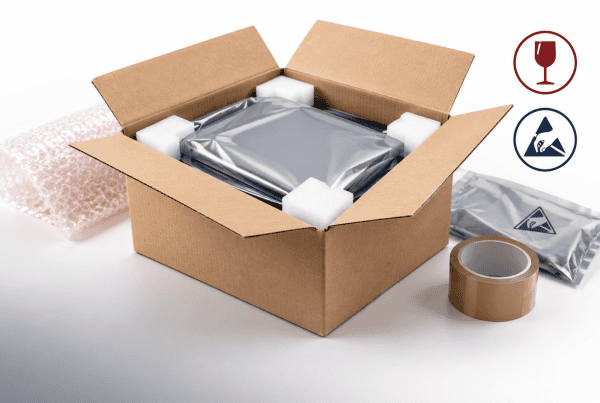
A 14x14x14 box sits in a useful middle ground: large enough for bulky products, bundled orders, and well-cushioned fragile items, but still compact enough for routine parcel handling. Its cube shape also makes the available space easy to understand.
The catch is that outside appearances can be misleading. A product that measures 12 inches across may not fit safely once wrapping, corner protection, or dividers are added. For shipping, the carton can also be billed as heavier than it actually weighs because carriers consider package volume.
This guide explains what 14x14x14 dimensions mean, how much usable space a box provides, what commonly fits inside, and how to decide whether this size is appropriate before you order or pack.
Key takeaways
- A 14x14x14 box has a nominal volume of 2,744 cubic inches, or about 1.59 cubic feet.
- Published corrugated carton dimensions commonly refer to interior packing space, while carriers generally need the finished package’s exterior dimensions.
- A cube box works especially well for objects that need similar clearance on several sides rather than long or flat products.
- Product dimensions alone are not enough. Measure the item after adding the protection it will actually need.
- At 2,744 cubic inches, this carton is large enough for dimensional weight to matter on many parcel shipments.
- A good fit leaves enough room for protection without requiring large amounts of filler just to stop the contents from moving.
What a 14x14x14 box actually gives you
The three measurements describe the carton’s length, width, and height. Because all three sides are equal, a 14 inch cube box has a simple, symmetrical shape that suits products with similar width, depth, and height.
The nominal cubic volume is:
14 x 14 x 14 = 2,744 cubic inches
Divide that by 1,728 cubic inches per cubic foot, and the carton represents about 1.59 cubic feet of nominal interior volume. That number is useful for comparing cartons, but it should not be treated as 1.59 cubic feet of unrestricted product space.

Inside dimensions and outside shipping dimensions are different
Corrugated box dimensions are often listed as usable inside dimensions. That lets buyers determine whether an item can physically fit inside the carton. The Collin Box box size guide explains the distinction between carton dimensions and the outside measurements carriers use when rating a finished parcel.
Once the carton is erected, filled, and taped, its exterior can measure slightly larger because the corrugated board has thickness and the flaps and seams affect the finished shape.
That difference matters in two situations:
- When checking whether an object will fit, work from the carton’s stated inside dimensions.
- When purchasing postage or obtaining a carrier quote, measure the closed package itself.
UPS package measuring guidance similarly instructs shippers to measure length, width, and height and use those package measurements when creating a shipment.
Why 2,744 cubic inches does not mean you can fill every inch
Protective packaging consumes part of the available volume. A wrapped ceramic planter with a finished protected size of 12 x 12 x 12 inches, for example, already occupies 1,728 cubic inches before additional top, bottom, or corner support is considered.
Irregular shapes use space even less efficiently. A rounded lamp base may occupy only part of the calculated cubic volume, but its widest points still determine the carton size it needs.
For that reason, choose boxes by the packed dimensions of the product, not by volume alone.
| Measurement | 14x14x14 box |
| Nominal length | 14 in. |
| Nominal width | 14 in. |
| Nominal height | 14 in. |
| Nominal cubic volume | 2,744 cu. in. |
| Approximate cubic feet | 1.59 cu. ft. |
| Length plus girth | 70 in. |
| Shape | Cube |
The length-plus-girth figure is calculated as 14 + (2 x 14) + (2 x 14), or 70 inches. Carrier rules vary by service, so treat this as a measurement reference rather than an indication that every service will price the parcel the same way.
How to tell if a 14x14x14 shipping box fits
The quickest sizing mistake is measuring a bare product and ordering a box with nearly identical measurements. That can work for durable goods requiring little protection, but it leaves very little tolerance for fragile products.
Instead, build the packaging around the final packed footprint.
Measure the product at its widest points
Start with the actual item or the complete order that will be packed together. Record its maximum length, width, and height rather than measuring only its regular-looking surfaces.
For an irregular product, imagine the smallest rectangular shape capable of enclosing it. A bowl with a 10-inch rim and a 7-inch base still needs clearance for the 10-inch diameter.
Multiple products should be arranged as they will actually ship. Do not simply add their individual volumes because the pieces may not nest efficiently.
Add the protective packaging before choosing the carton
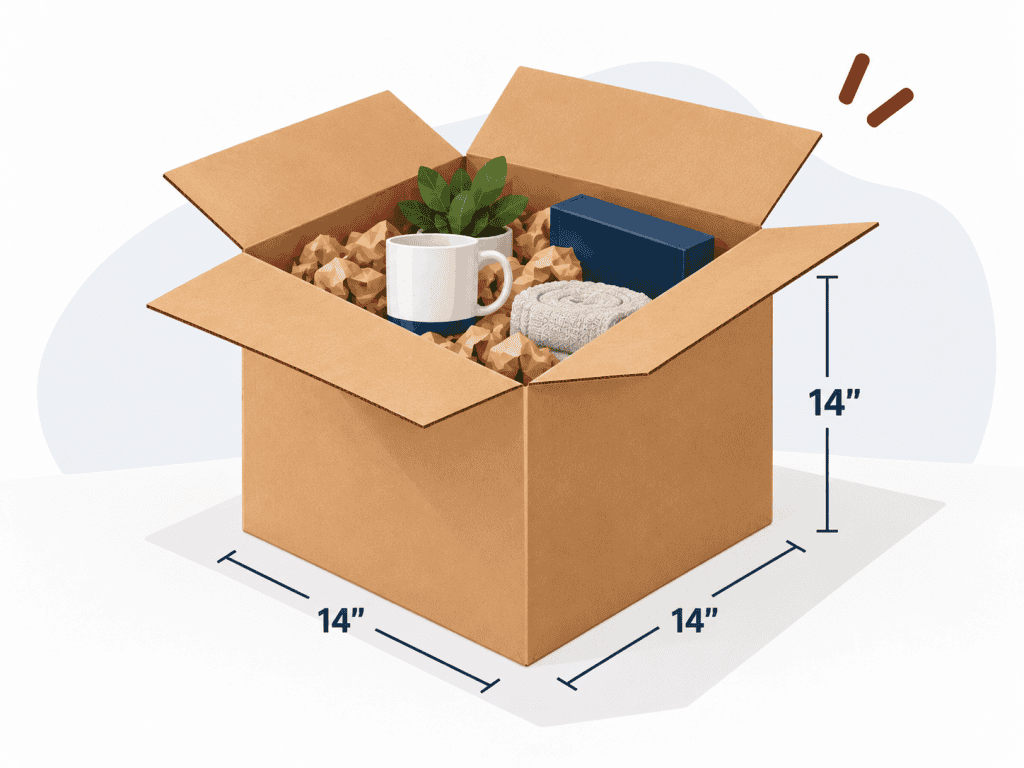
Next, determine what each side needs for protection. That may include foam wrap for a finished surface, bubble cushioning around breakables, corrugated pads, corner protectors, partitions, or paper used to control movement.
If you are unsure which protection method fits the product, compare the roles of wrapping, cushioning, and void fill in this guide to protective packaging materials.
Suppose you need to ship a decorative object measuring 10 x 10 x 10 inches. After wrapping and adding corner protection, its packed footprint becomes about 12 x 12 x 12 inches. A 14x14x14 shipping box then leaves approximately one inch around each side if the object is centered.
That could be a reasonable starting configuration for some products. It would not automatically be appropriate for highly fragile, heavy, or valuable goods that require a thicker protective system.
Check fit in three dimensions, not just one
A common oversight is confirming the item’s length and width while forgetting its height after cushioning.
For example:
- A 12 x 12 x 9-inch product may fit easily with top and bottom protection.
- A 13.5 x 10 x 10-inch rigid product leaves very little room along its longest dimension.
- A 10 x 10 x 13-inch fragile item may technically fit but leave insufficient top clearance.
- Two 7-inch products may not fit side by side once each is individually wrapped.
The 14x14x14 dimensions are most useful when the packed product remains reasonably balanced in all three directions.
Do a test pack before buying large quantities
For recurring business shipments, assemble one complete package using the intended carton, product, inserts, wrapping, filler, and tape.
Then check three things:
- The product should not press tightly against the box walls unless the packaging system was specifically designed that way.
- The contents should not noticeably shift during a gentle shake test.
- The carton should close normally without bulging or requiring downward force on the flaps.
A successful test pack gives you much more useful information than comparing catalog dimensions on paper.
Common applications for a 14 inch cube box
A large cube box is useful because it accommodates depth better than flatter cartons while avoiding some of the excess volume of larger 16-inch, 18-inch, or 20-inch cubes.
The box index lists a 14-inch cube alongside smaller, larger, rectangular, and heavy-duty carton sizes, which makes it easier to compare proportions before choosing one.
Bundled eCommerce orders
A 14-inch cube can work well when several smaller retail products need to ship as one order. Examples might include boxed personal-care products, hobby supplies, packaged home goods, small accessories, or a mixed merchandise order.
The important distinction is density. Six lightweight boxed products may be an easy fit, while several compact metal components occupying the same physical space could make the carton much heavier.
Businesses shipping repeat product combinations can improve consistency by documenting a standard pack pattern. Record which items go in the carton, their orientation, protective materials, and final package weight.
Small appliances and household products
Compact kitchen appliances, home accessories, organizers, and similarly shaped household items may fit well in a 14-inch cube when their protected dimensions stay comfortably below the carton size.
Original retail packaging changes the calculation. A product itself may be 10 inches wide, but its retail carton may already measure 12 or 13 inches. If that package then needs to sit inside an outer shipping carton, measure the retail carton rather than the appliance.
Fragile decorative items
Vases, ceramics, collectibles, small lamps, and decorative products can benefit from a cube because protection can be built around several sides at relatively even depths.
However, “it fits” and “it is safely packed” are different tests. Fragile goods should be wrapped individually and prevented from reaching the outer walls during normal movement.
For especially delicate goods, a larger carton or box-in-box system may be more appropriate than trying to force all protection into a 14-inch cube.

Office, warehouse, and parts storage
A 14-inch cube can also make a practical storage carton for supplies, samples, packaged components, cables, small tools, or stock awaiting fulfillment.
Cube boxes stack predictably when loads are suitable for stacking, but weight still needs attention. A cube filled with soft goods behaves very differently from the same carton filled with dense hardware.
Avoid filling a carton simply because unused space remains. The material strength of the carton, bottom closure, lifting method, and weight of the contents all matter.
Moving lighter household goods
A 14x14x14 moving box can hold smaller household items such as linens, pantry goods, toys, craft supplies, bathroom items, desk contents, and individually wrapped kitchen pieces.
It is smaller than many general-purpose household moving cartons. That can be useful when you want to keep individual boxes manageable rather than building very heavy loads.
For larger moves, compare the cube against purpose-specific household moving boxes and supplies. Dish packs, wardrobe cartons, and larger moving boxes are designed around different contents and should not automatically be replaced by a cube carton.
When this size is probably the wrong choice
A 14-inch cube is less attractive when the product is long and narrow, very flat, extremely dense, or only a few inches tall.
A 13 x 5 x 4-inch item technically fits, for example, but the box leaves a large amount of unused space. A 14 x 6 x 4 or similar rectangular carton may require less void fill and produce a smaller shipping footprint.
Likewise, a 15-inch-long rigid product will not fit just because its overall volume is less than 2,744 cubic inches. Every required dimension must fit independently.
Shipping cost and carrier considerations
For parcel shipping, carton size can affect the bill even when the package is light. Carriers use dimensional or volumetric weight rules to account for the amount of vehicle space a parcel occupies.
A 14-inch cube deserves particular attention because its volume is 2,744 cubic inches.
Dimensional weight can exceed actual weight
FedEx explains dimensional weight as the relationship between a package’s volume and actual weight. For applicable U.S. shipments, FedEx shows a divisor of 139.
Using the nominal 14-inch dimensions as a simple illustration:
14 x 14 x 14 = 2,744
2,744 / 139 = approximately 19.74 pounds
That means a parcel with those measured exterior dimensions can have a dimensional weight of roughly 20 pounds under a 139 divisor, even if the contents physically weigh much less. Actual billing depends on the carrier, service, finished exterior measurements, rounding rules, and your shipping agreement.
This is why using a large carton for a small lightweight product can cost more than expected.
USPS treats packages over one cubic foot differently on some services
One cubic foot equals 1,728 cubic inches. A 14-inch cube is larger than that threshold at 2,744 cubic inches.
The current USPS Domestic Mail Manual states that dimensional-weight pricing can apply to eligible USPS Ground Advantage commercial parcels sent to applicable zones when volume exceeds one cubic foot. USPS provides its own formula and conditions, which differ from FedEx rules.
Do not assume a DIM calculation from one carrier can be copied into another carrier’s rate system.

Always measure the finished package
The calculation above uses nominal dimensions to illustrate scale. When purchasing postage, use the finished exterior dimensions of the sealed box.
A carton sold as 14 x 14 x 14 inches may have an outside measurement above 14 inches on one or more sides. Depending on carrier rounding practices, that can alter the rated cubic size.
Measure after:
- The carton has been erected.
- All contents and cushioning have been added.
- The flaps have been closed.
- Tape has been applied.
- Any exterior bulging has been corrected.
Also weigh the fully packed carton rather than the product alone.
Right-sizing matters more than simply choosing the smallest box
The smallest possible carton is not always the cheapest overall choice if it causes product damage, slows packing, or cannot accommodate necessary protection.
A better goal is the smallest properly protective packaging configuration.
For a durable product, that might mean a close-fitting carton with limited filler. For a fragile product, the correct package may be larger because cushioning space is part of the protection system.
A practical packing process for a 14x14x14 box
If you are deciding whether this size belongs in your shipping or moving inventory, use a repeatable process rather than judging by eye.
Step 1: Measure the item in its shipping configuration
Include retail packaging, bags, bundled accessories, inserts, or anything else that stays with the product. Measure irregular objects at their widest points.
For multi-item orders, arrange the products in a realistic pack pattern first.
Step 2: Decide what protection each surface needs
Identify what can realistically damage the product. A scratch-sensitive object may need foam wrap. A breakable object may need impact cushioning. Several products may need dividers so they cannot strike one another.
Do not use large amounts of loose filler as a substitute for wrapping a fragile product correctly.
Step 3: Measure the protected item again
After wrapping, measure the finished protected footprint.
If any dimension approaches 14 inches, stop and assess whether there is enough room for the remaining packaging components. A product does not need to physically jam against the wall before a carton becomes too tight.
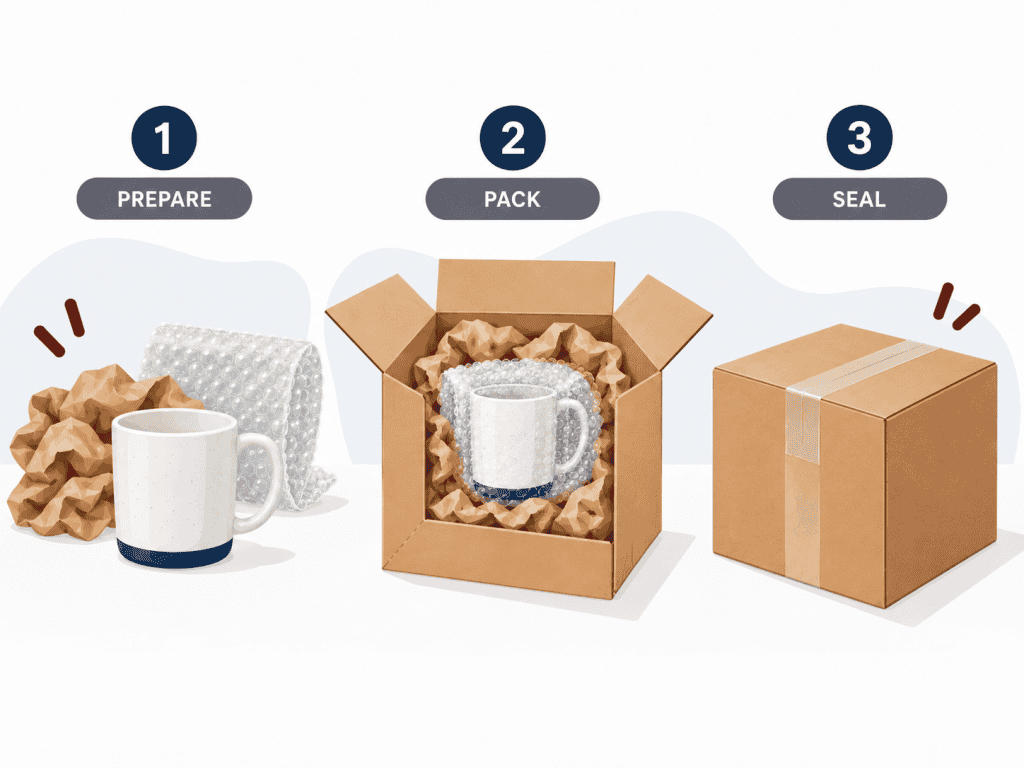
Step 4: Build the package from the bottom up
Prepare the bottom closure securely, add the planned base protection, and place the product in its intended position.
Fill side and top spaces according to the packaging plan. Keep the contents centered when impact protection depends on separation from the carton walls.
Step 5: Close and test the carton
The top should close without bowing. Give the package a gentle shake and listen or feel for internal movement.
If the contents shift significantly, add appropriate restraint or reconsider the carton size. If the box is packed with filler simply because there is too much empty space, test a smaller size.
Step 6: Record the final measurements and weight
Measure all three exterior dimensions and weigh the completed package.
For repeat shipments, record:
| Packing specification | What to document |
| Carton | Exact box size and type |
| Product arrangement | Quantity and orientation |
| Wrapping | Material and number of layers |
| Cushioning | Type and placement |
| Void fill | Material and approximate amount |
| Closure | Tape type and pattern |
| Finished size | Exterior L x W x H |
| Finished weight | Complete packed weight |
This creates a repeatable specification for employees and makes carrier cost comparisons more meaningful.
Step 7: Compare a nearby size before standardizing
If you regularly ship the same product, test at least one smaller or differently proportioned carton.
You may find that a rectangular box cuts excess volume without sacrificing protection. On the other hand, the 14x14x14 box may prove more efficient because it simplifies packing and accommodates several common order combinations.
The best box is not necessarily the one with the lowest unit price. Consider carton cost, cushioning consumption, packing time, shipping charges, damage risk, and the number of different sizes your operation needs to keep in inventory.
Choose the box around the packed product
A 14x14x14 box is most useful when the contents genuinely need a cube-shaped space and enough clearance remains for the right protective materials. Its 2,744 cubic inches provide useful capacity for shipping, moving, storage, and bundled orders, but that volume also makes shipping dimensions worth checking carefully.
Measure the protected product, test the complete pack, and compare the finished size and weight against your carrier’s rules. That simple process tells you far more than choosing a carton by product dimensions alone.
FAQs
What are the exact 14x14x14 dimensions?
A 14x14x14 box is nominally 14 inches long, 14 inches wide, and 14 inches high. For corrugated cartons, listed dimensions commonly describe interior packing space, so measure the sealed exterior separately when preparing a shipment.
How many cubic inches are in a 14x14x14 box?
A 14x14x14 box has a nominal volume of 2,744 cubic inches. That is approximately 1.59 cubic feet, although cushioning, dividers, and irregular product shapes reduce the space actually available for merchandise.
Is a 14x14x14 box considered a large box?
It is reasonably described as a medium-to-large parcel carton or large cube box, but box-size labels are not universal. Some suppliers or movers may classify it differently based on their own product ranges.
What can I ship in a 14x14x14 shipping box?
Common candidates include bundled retail orders, compact household products, decorative objects, small appliances, packaged components, and fragile items that need cushioning. Suitability depends on the product’s protected dimensions, weight, fragility, and carrier requirements rather than its category alone.
Is a 14x14x14 box good for moving?
A 14x14x14 moving box can be useful for relatively compact household goods, especially when keeping individual loads manageable matters. For dishes, clothing on hangers, mirrors, or bulky household contents, purpose-specific moving cartons may provide a better shape or construction.
How much cushioning should I put in a 14-inch cube box?
There is no universal cushioning thickness that is safe for every product. Determine the amount based on the item’s weight, fragility, shape, value, and likely shipping conditions, then confirm the package through an appropriate packing test.
Does a 14x14x14 box have dimensional weight?
It can. A 14-inch cube has 2,744 cubic inches of nominal volume, so dimensional-weight rules may affect many parcel services. Measure the completed package and check the current rules for the specific carrier, service, destination, and shipping account before calculating cost.